
 Back
BackCreating an Accessible Survey
Our approach to accessibility
We take an inclusive design approach to accessibility. This means we design our products with people with access needs in mind, and test with people who use assistive technology.
We use the international standard Web Content Accessibility Guidelines (WCAG) 2.2 Level AA as our benchmark. The survey-taking experience on our current platform has been independently certified against WCAG 2.2 Level AA by the Digital Accessibility Centre (DAC). Find out more in our Accessibility Statement.
An accessible platform is the foundation, but the content of your survey matters too. This guide covers the settings and content choices that will keep your survey accessible for every respondent.
Accessibility is built in on the current platform
On our current survey platform, accessibility is built into every survey as standard. There is no separate accessible theme to choose. Every survey supports screen readers, keyboard-only use, browser zoom up to 400%, and high contrast and inverted colour modes, and every question type is accessible.
You can tell which platform a survey runs on from its link: links containing /t/ run on the current platform, and links containing /s/ run on the classic platform.
Using the legacy platform?
On the legacy platform (survey links containing /s/), accessible surveys are built with the dedicated accessible theme. See the section below, and read our legacy platform accessibility statement for known issues.
Creating the survey
- Click “Create a survey”
- Set your survey up from scratch, by copying an existing survey, or using one of our templates.
Legacy platform only: select an accessible theme
If your survey runs on the legacy platform, choose an accessible theme once you’ve set up your survey:
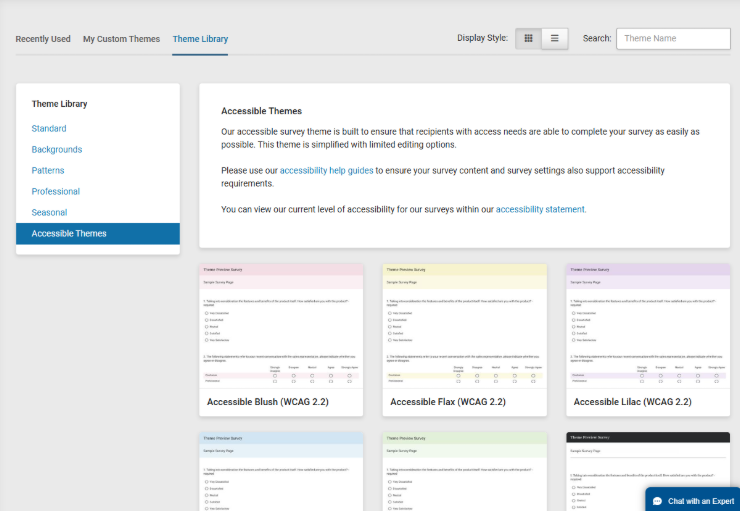
Go to your theme library and then choose the "Accessible Themes" category. In this category, choose from our list of Accessible Themes. These themes have been tested in line with their corresponding WCAG rating to ensure a high level of accessibility compliance.
On the current platform you can skip this step. Every theme is accessible, though if you customise colours you should check your text keeps enough contrast against its background. See our guide on checking colour contrast in your survey.
- WCAG 2.2 AA checkpoints: 1.4.3 Contrast (Minimum) (AA)
Recommended Survey Settings
Use these settings to ensure your survey is as accessible as possible. These are presented split into the tabs they appear on in the Survey Settings.
Under each setting, we've put the WCAG 2.2 Checkpoint(s) that it deals with.
General Settings
Provide a meaningful survey title.
The page title is the first content item screen reader users encounter when they navigate to a new page. Therefore, a unique page title assists with orientation.
- WCAG 2.2 checkpoints: 2.4.2 Page titled (A).
Select “show title”.
Select this option to avoid empty headings.

Figure 1: Survey title options
- WCAG 2.2 AA checkpoints: 1.3.1 Info and relationships - Headings (A)
Appearance Settings
Show question numbers and page numbers.
Question numbers are helpful for all users. Numbers also assist screen reader users to distinguish questions.
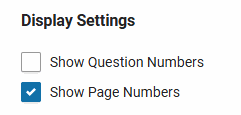
Figure 2: Enable question numbers and page numbers
Use meaningful words for buttons.
Avoid abbreviations for button text. By default, we provide a short descriptive phrase for the next and previous buttons.
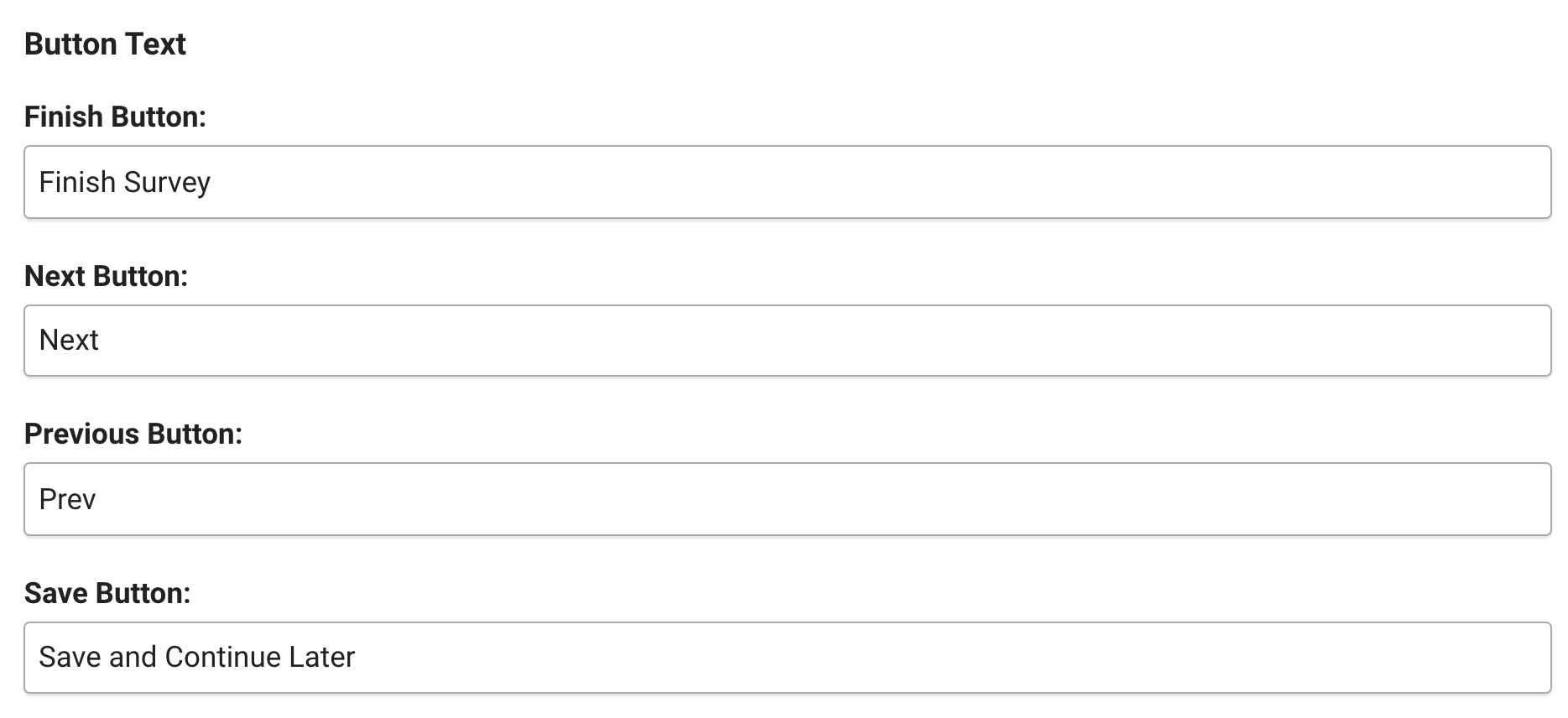
Figure 3: Default labels for buttons
Add progress bar
Help respondents keep track of their progress. This is especially important for longer forms.

Figure 4: Enable the progress bar
- WCAG 2.2 AA checkpoints 1.3.1 Info and relationships - convey meaning programmatically (A)
Other settings
Enable save and continue
Save and continue allows respondents to complete the survey in their own time. This is especially helpful for anyone who finds filling out forms difficult and might not be able to, or want to, complete the survey in a single session.
Provide headings and page titles
Headings <H1> to <H6> provide structure to web content. Users who rely on assistive technologies such as screen readers can navigate content quickly using headings. Headings can also enhance SEO.
SmartSurvey surveys use headings throughout: on our current platform the survey title is the top-level heading and each question is a heading below it, so screen reader users can jump between questions using heading shortcuts. If a page title isn’t provided it will appear as an empty heading. This is unlikely to be a barrier for users, though it is a minor issue.
To achieve WCAG compliance for headings, always include a page title for each individual page of your survey, and make each page title unique.
Adding a page title
- In the Survey Design page of your survey, locate the page you want to edit
- In the Page Options menu for the page, click Edit
- Add a page title. This will also appear as a heading
- Click the green Save Page button to save your changes
- Repeat for every page of your survey
Figure 5 Page title field

Figure 6 Headings highlighted using the web developer toolbar.
- WCAG 2.2 checkpoints: 1.3.1 Info and relationships (A)
Make your content accessible
An accessible survey also needs accessible content. These guides will help: